Apricot Tree Academy began with a sentence no parent should have to hear: “Dyslexia isn't real.” A school psychologist said it to one of our founders about her own struggling reader. She knew better — and instead of waiting for the system to catch up, she set out to build something parents could use right away. This is the story of how that decision became a curriculum.
The moment we were told dyslexia wasn't real
Plenty of parents know this feeling. You can see that your child is bright. You can also see that reading is a daily fight — the same word missed twice on one page, letters that flip, homework that ends in tears. You ask for help, and instead of answers you get doubt: maybe they'll grow out of it, maybe it's not really dyslexia, maybe dyslexia isn't a real diagnosis at all. For one of our founders, that doubt came straight from a school psychologist. It was the moment that started everything.
Who we are
Apricot Tree Academy was founded by two people who came at this problem from different directions and met in the middle.
- Cynthia Glunt, M.Ed is an instructional designer and entrepreneur with more than a decade of experience in adult learning, curriculum strategy, and EdTech. She designs parent-friendly tools that make it easier for families to support dyslexic children.
- Sandra Dallon, M.Ed taught elementary school for six years, earned a certificate from the Dyslexia Training Institute, and has tutored children in reading for over ten years. She had long wanted to build a reading curriculum parents could use at home.
You can read our full bios on the About Apricot Tree Academy page.
Why we built a curriculum for parents
The hard truth we kept running into is that the methods which actually help children with dyslexia are not a secret — they're just hard to get. Orton-Gillingham and structured literacy are well-established, research-backed approaches, but they have often been locked behind specialist training, long evaluation waitlists, and the cost of private tutoring. Families would learn their child had dyslexia and then be told to wait months for services that might never be enough.
We didn't think parents should have to wait. Reading instruction that works is something a committed parent can deliver at the kitchen table — if someone hands them the plan. So we decided to be the ones to hand it over.
What we built
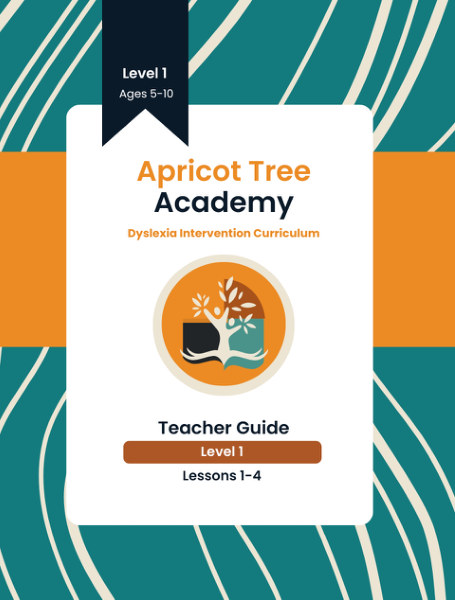
The result is our Dyslexia Intervention Curriculum: an Orton-Gillingham-based, structured, multisensory reading program written for parents, not specialists. It is explicit and systematic — each skill builds on the last — and multisensory, so a child sees a letter, says its sound, and writes it, building stronger connections for reading and spelling. A teacher/parent guide tells you exactly what to teach and how, and a student workbook gives your child the hands-on practice structured literacy depends on. No teaching background required. You can read the full announcement in our curriculum press release.
You don't have to wait
If you are where we were — certain that something is wrong, and tired of being told to be patient — this is the heart of why we exist. Early, structured, consistent instruction is what changes outcomes for children with dyslexia, and you can start providing it now.
My experiences have taught me that dyslexic children are brilliant. Their brains may work differently than many others, but they are amazingly gifted.
— Sandra Dallon, Co-Founder
That belief is the reason Apricot Tree Academy exists, and it's behind every lesson we write.
Frequently Asked Questions
Who founded Apricot Tree Academy?
Apricot Tree Academy was founded by Cynthia Glunt, M.Ed, an instructional designer and parent, and Sandra Dallon, M.Ed, a former elementary teacher who is certified through the Dyslexia Training Institute and has tutored children in reading for over ten years.
Why was Apricot Tree Academy created?
It was created to put effective, research-aligned dyslexia instruction directly in parents' hands. Many families face long waitlists, limited school services, or expensive private tutoring, even though the methods that help — Orton-Gillingham and structured literacy — are well established. The founders built a curriculum parents can teach at home so families do not have to wait.
What does “the school psychologist told me dyslexia wasn't real” mean?
It refers to a moment many parents recognize: being told their struggling reader does not have dyslexia, or that dyslexia is not a real diagnosis, when their own observations say otherwise. Apricot Tree Academy was built by a parent who was given that message and refused to accept it.
What did the founders build?
They built the Dyslexia Intervention Curriculum, an Orton-Gillingham-based, structured, multisensory reading program designed for parents to use at home with children ages 5 to 10, with no teaching experience required.
Where can I learn more about the founders?
You can read full bios for Cynthia Glunt and Sandra Dallon on the About Apricot Tree Academy page, and watch the founders story video on this page and on the About page.